
Technology
Technological equipment
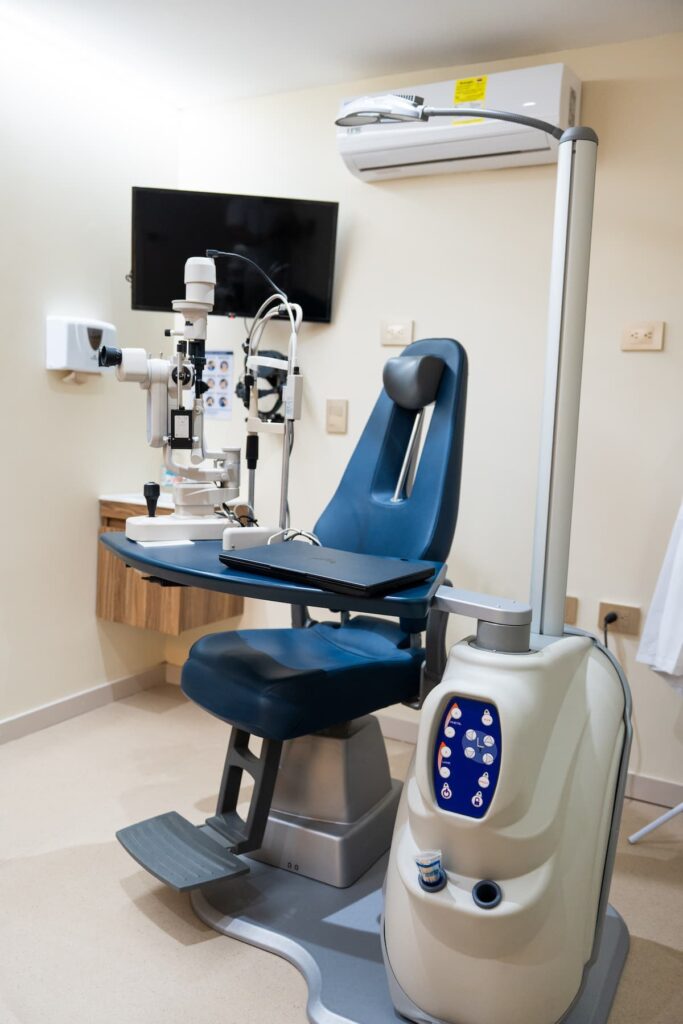
Argon Laser
Used for non-invasive outpatient treatments of retinal pathologies such as diabetic retinopathy, peripheral retinal degeneration, retinal holes, retinal vein occlusions, retinal detachments, among others. It is the first Argon laser in the city without fiber optics, using Bluetooth communication technology and AI. It also allows us to perform scarless treatments, ideal for pathologies affecting the macula, the area of greatest vision in the retina.
Nd:YAG Laser (Neodymium:Yttrium Aluminum Garnet)
Used for fast, comfortable, and risk-free treatments, completely outpatient, non-invasive, and with rapid recovery from ocular disorders such as narrow-angle glaucoma, clearing opacities of media such as the posterior capsule, among others. It is also the first laser in the city with technology to treat vitreous opacities quickly and safely in people with bothersome symptoms such as floaters.
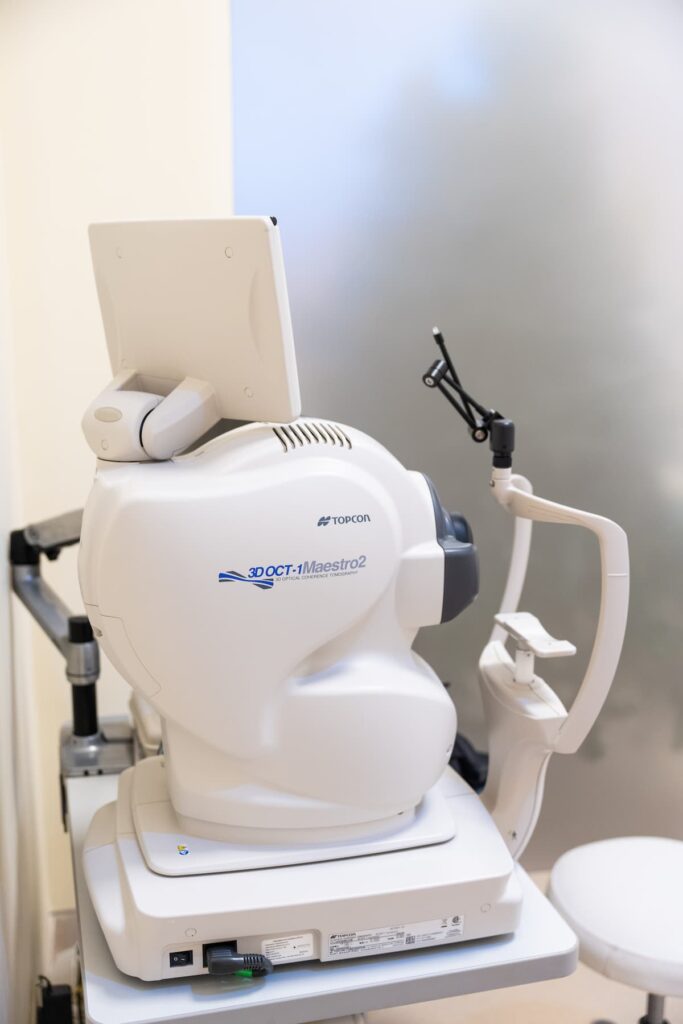
Optical Coherence Tomography (OCT) and Angio-OCT
Cutting-edge technology used by NASA, applying spatial vision principles to medical applications, provides an important diagnostic tool with very high resolution. It allows us to perform near-histological studies of the most specialized superficial and deep tissues of the eyeball with a single scan. This technology also allows us to identify vascular flow without contrast agents in retinal vessels such as those of the optic nerve. We can analyze the cornea, iridocorneal angles, obtain color photographs of the eyeball and posterior pole, and study the structure of the retina and optic nerve, including measurements and identification of their blood vessels.
Corneal Topography (Pentacam)
This highly useful equipment is used to study the cornea, including its curves, elevations, and thicknesses. It allows us to identify diseased corneas and offers possibilities for surgical correction of refractive errors through refractive surgery, among other procedures. Pentacam is the standard equipment used in leading studies and consensus assessments of corneal pathologies worldwide, making it universally applicable in the interpretation of its results.
Ocular Ultrasound
A specialized diagnostic study that uses ultrasound to evaluate the internal structures of the eye, allowing for the detection of abnormalities that cannot be visualized directly through a conventional examination.
Computerized Visual Field Testing (CFT)
Advanced diagnostic technology that allows for the evaluation of the visual field and the detection of peripheral vision abnormalities, making it essential for the diagnosis and monitoring of diseases such as glaucoma and other neurological or ocular pathologies.
Optical Coherence Tomography (OCT) of the Cornea and Iridocorneal Angles
A high-precision study that allows for the analysis of corneal structures and the ocular drainage angle, facilitating the early diagnosis and monitoring of diseases such as glaucoma and corneal abnormalities.
Optical Coherence Tomography (OCT) of the Macula and Optic Nerve
Advanced technology that generates detailed images of the retina and optic nerve, allowing for the detection and monitoring of diseases such as glaucoma, macular edema, and macular degeneration.
Optical Coherence Tomography Angiography (OCT) of the Macula and Optic Nerve
A non-invasive examination that visualizes blood flow in the retina and optic nerve without the need for contrast agents, providing accurate diagnoses and advanced monitoring of ocular vascular diseases.